It usually starts at the kitchen table. Someone opens the TV bill, reads it twice, and asks the question out loud: "Are we really paying this much to watch the same ten channels?" That moment, repeated in homes from Victoria to St. John's, is the simplest explanation of why Canadians are ditching cable for IPTV in 2026.
But the price is only the first chapter. The shift is also about how people watch now: on phones in the bus, on a tablet in the kitchen, on a big 4K TV for the playoffs. Cable was built for one screen in one living room. This article looks at the forces behind cord-cutting in Canada, what people honestly miss after they leave, what they never think about again, and how to make the move without regrets.
Why Canadians Are Ditching Cable for IPTV: It Started With the Bill
Canadian TV bills have a familiar pattern. The first year looks reasonable thanks to a promotion. Then the promotion ends, the regular rate kicks in, and small line items appear: a receiver fee, a sports add-on, a charge for the second TV in the basement.
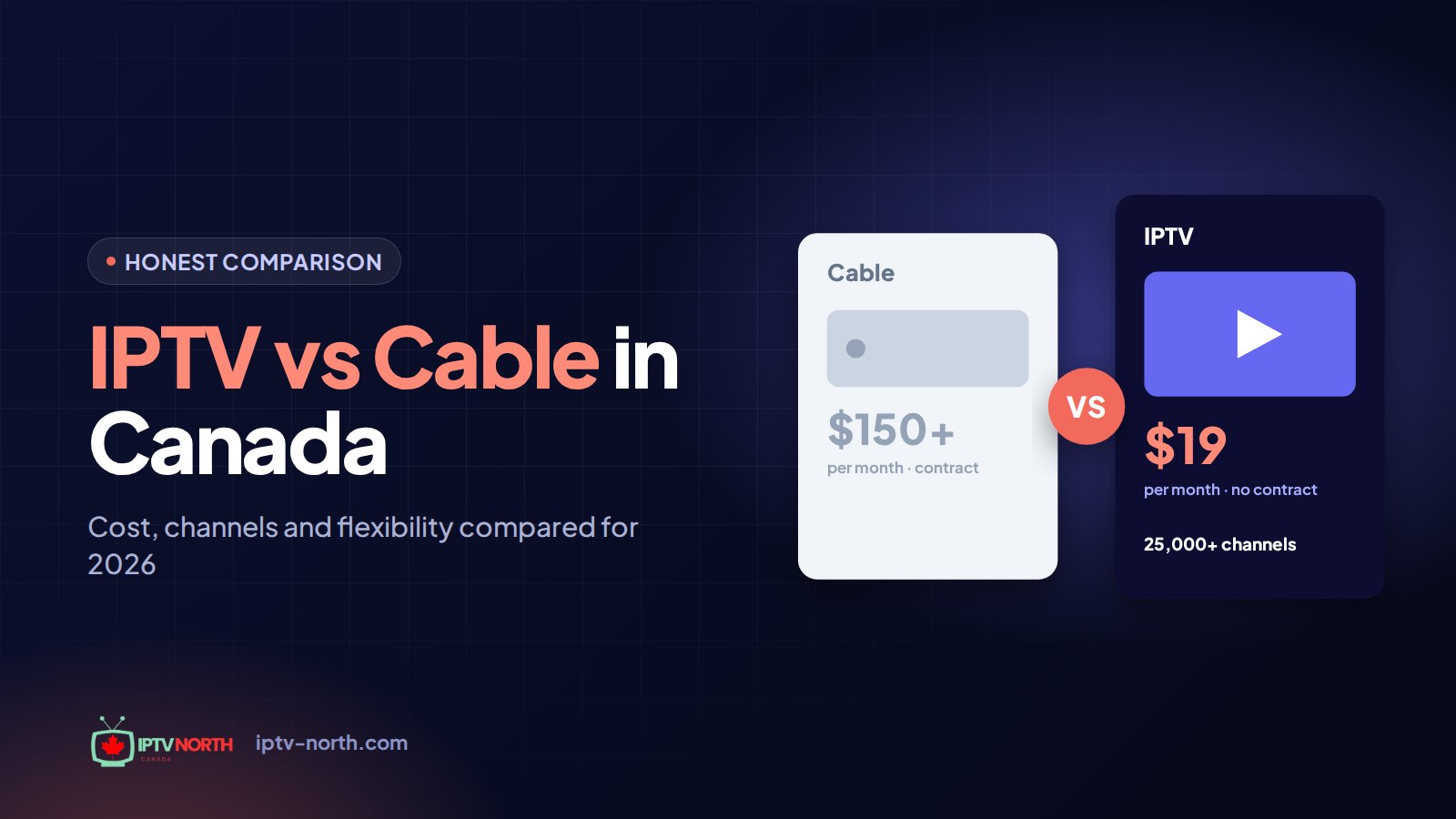
None of these is shocking on its own. Together, they turn a "good deal" into a bill that often passes $100 a month. At that point, households start doing the math, and the comparison with IPTV is hard to ignore:
| What households compare | Typical cable experience | IPTV North |
|---|---|---|
| Monthly price | Often over $100 after promotions | $19 for 1 month, or $79 for 12 months |
| Sports channels | Frequently sold as an add-on | TSN, Sportsnet, RDS, TVA Sports included |
| Commitment | Terms and possible cancellation fees | No contract |
| Hardware | Rented receiver per TV | Your own device |
| Trying before buying | Rarely possible | 24-hour trial for $2.99, paid by Interac e-Transfer |
For a full breakdown of the numbers, see our IPTV vs cable comparison.
Six Forces Behind Cord-Cutting in Canada
Price opens the door, but several other forces push people through it.
1. Paying for Channels Nobody Watches
Bundles made sense when there were fifty channels. Today, most families watch a short list: local news, a few series, sports, maybe a kids' channel. Paying for hundreds of others feels increasingly pointless.
2. Sports Spread Across Tiers
Hockey fans feel this one most. Following the Oilers, the Jets or the Canadiens across a full season can mean regional feeds, national broadcasts, French-language coverage and specialty channels. On cable, that often means extra tiers. On IPTV North, TSN, Sportsnet, RDS, TVA Sports and CBC sit in the same lineup, with NHL, CFL, NBA and MLB games included. Our article on streaming every Canadian NHL team shows how that works in practice.
3. Screens Everywhere
Kids watch on tablets, parents catch the news on phones, and the big TV is saved for movies and games. Cable is built around a box tied to a TV. IPTV works on Fire TV Stick, Android TV, Smart TVs, iPhone and iPad, Apple TV, Windows and Mac, and boxes like MAG, BuzzTV and Formuler.
4. Contracts Feel Out of Step
Canadians now rent cars by the hour and cancel apps with one tap. A multi-year TV term, with a fee for leaving early, feels like a relic. IPTV North sells simple periods: 1, 3, 6 or 12 months, with nothing to cancel at the end.
5. Content in Many Languages
Canada is multilingual and multicultural. Franco-Ontarian families want RDS and TVA outside Quebec. Newcomers want channels from home. On cable, these often come as paid packages. IPTV North's 25,000+ live channels include a large international selection alongside Canadian networks.
6. Better Internet at Home
Fibre and faster cable internet from Rogers, Bell, Telus, Vidéotron and regional providers have made streaming dependable in most cities and many towns. Once the connection is good enough for 4K, the argument for a separate TV line weakens.
What People Actually Miss After Leaving Cable
Honesty matters here. Most people who leave cable do not look back, but a few things take some adjusting.
- Independence from the internet. When your home internet goes down, so does IPTV. Cable kept running during an internet outage. The fix: a reliable ISP and a router that is not ten years old.
- One familiar box. Older family members sometimes miss the simplicity of a single remote and a channel number. A clean player with favourites set up in advance goes a long way.
- Channel surfing by number. Some IPTV players let you jump by number; others lean on the guide and search. It takes a week or two to feel natural.
- A technician who handles everything. With IPTV, you set it up yourself. The good news is that it takes minutes, and IPTV North's Canadian support team helps 24/7 by chat and at service@iptv-north.com.
What Nobody Misses
Ask former cable subscribers what they do not miss, and the list comes quickly:
- The annual price increase letter
- Calling to renegotiate every time a promotion ends
- Paying extra so the basement TV works
- Returning equipment and keeping the receipt, just in case
- Discovering that the game is on a channel that is not in your package
- Waiting days for an installation appointment after moving
Three Canadian Households, Three Reasons to Switch
Every story is slightly different. Here are three typical ones.
Edmonton: the hockey family. Two parents, two teenagers, and an Oilers schedule on the fridge. Their frustration was sports channels split across packages. After a $2.99 24-hour trial on a busy game night, they moved to IPTV on the living room TV and a phone for away games at the rink.
Quebec City: the retired couple. They watched TVA, Radio-Canada and a few series, and felt they were paying for far more. Their grandson installed a player on a Fire TV Stick, set up favourites, and showed them the guide. The biggest change for them: no more monthly shock, just a single yearly payment of $79.
Hamilton: the newcomers. A young family that arrived from abroad wanted Canadian news and hockey to feel at home, plus channels from their country of origin for the grandparents on video calls. Cable required several add-ons. IPTV put both in one lineup.
The Winter Factor
Canadian winters play a quiet role in this story. From November to March, TV is on more often: long evenings, snow days, the heart of the NHL season, the Grey Cup, the world juniors over the holidays. That is exactly when a bloated bill feels heaviest, and when families notice which channels they actually use.
It is also when a flexible setup shines. A snowstorm closes schools in Ottawa, and the kids watch on a tablet while a parent works from the kitchen with the news on a phone. With cable, that usually means one TV in one room. With IPTV, the same service follows everyone around the house.
Is IPTV the Only Way to Cut the Cord?
Not at all. Canadian cord-cutters usually combine a few tools:
- Over-the-air antenna for local networks in larger cities
- On-demand streaming apps for original series
- IPTV for live channels, sports and a large movie and series library in one place
The reason IPTV often becomes the core of the setup is live TV. Streaming apps are great for binge-watching, but they do not replace TSN on a Saturday night or live news during a winter storm. IPTV North covers live channels in 4K and FHD plus 120,000+ movies and series, which is why many households find they need fewer extra subscriptions than expected.
Where IPTV North Fits In
If you are thinking about joining the Canadians who are ditching cable for IPTV, here is what IPTV North offers, in plain terms:
- 25,000+ live channels, Canadian and international
- 120,000+ movies and series on demand
- 4K and FHD where available
- Plans for one device: $19 for 1 month, $29 for 3 months, $49 for 6 months, $79 for 12 months (CAD)
- No contract, pay by Interac e-Transfer
- 24-hour trial for $2.99, paid by Interac e-Transfer
- Canadian support 24/7 by chat and email
Compare the options on the IPTV plans page.
How to Leave Cable Without Regrets
People who are happiest after switching tend to follow the same simple path:
- Test first. Start the 24-hour trial for $2.99 and watch at your usual times, including a live game in the evening.
- Check your connection. A steady 10 Mbps handles FHD; about 25 Mbps is comfortable for 4K. Wire the main TV device to the router if you can.
- Read your cable agreement. Know your end date and any fee before you call.
- Keep internet, cancel TV. Confirm your internet-only price before hanging up.
- Set up favourites for everyone. Ten minutes spent building a favourites list makes the switch painless for the whole household.
If you need help with devices, the installation guide covers each one step by step.
A Note on Legality
IPTV is a technology for delivering TV over the internet, and the technology itself is legal. Canada's large telecom companies use similar IP-based delivery for their own TV services. Whether a specific service is lawful depends on the rights to the content it carries. This is general information, not legal advice.
Frequently Asked Questions
Why are so many Canadians cancelling cable TV?
Mostly because of cost and flexibility. Bills climb after promotions end, sports channels are often sold separately, and families watch on many screens. IPTV offers live channels, sports and on-demand content for a fraction of the price, without a contract.
Will I lose live sports if I cut the cord?
Not with IPTV North. TSN, Sportsnet, RDS, TVA Sports and CBC are included, so NHL, CFL, NBA and MLB games stay on your screen, in 4K or FHD where available.
Is cutting the cord hard for older family members?
It is easier than many expect. Choose a simple player, set up favourites in advance and show them the guide once. The $2.99 24-hour trial is a good way to check that everyone is comfortable before cancelling cable.
What internet speed do I need after leaving cable?
A stable 10 Mbps is enough for FHD on one device, and about 25 Mbps works well for 4K. If several people stream at once, a faster plan and a wired connection for the main TV help.
Do I need a VPN once I switch to IPTV?
Usually not. Most viewers stream without one. A VPN can help in specific cases, for example if your internet provider slows video traffic in the evening. Our guide on whether you need a VPN for IPTV in Canada explains when it is worth considering and when it only adds complexity.
Can I pay without a credit card?
Yes. IPTV North accepts Interac e-Transfer, and the $2.99 24-hour trial is paid the same way, with no credit card involved.
The Bottom Line on Why Canadians Are Ditching Cable for IPTV
The reasons Canadians are ditching cable for IPTV are practical, not trendy: bills that climb, sports spread across tiers, contracts that feel outdated, and families that watch on many screens. Cable still has one real advantage, independence from your internet, but for most households with a stable connection, IPTV simply fits modern life better.
If you are at the kitchen-table stage, the next step is easy. Try IPTV North for 24 hours for $2.99, watch your usual shows and a live game, and decide with real experience instead of a sales pitch.